
Manatee County Court Records After a Jail Arrest
The path from arrest to court record is short but easy to misread. A person is arrested, booked at the Central Jail, and seen by a judge at first appearance. The State Attorney then reviews the police reports and decides what to file. Those filed charges open the court case, and that case is the court record. Booking charges and filed charges are not always the same. The prosecutor can add, reduce, drop, or amend a charge.
Two sides of the same event live in two places. For the custody and booking side, use Manatee County jail inmate records and, for booking photos, the jail mugshots page. For the charges filed after an arrest, the case lives with the Clerk of Court. This page stays on the court records that follow an arrest: where they form, how to read them, and how to find them.
How to Find Manatee County Court Records After an Arrest
The Manatee County Clerk runs a public records hub for court cases. The Clerk court records search lets you look up a case by a person's name, a business name, a case number, a citation number, or a case type. The arrest and booking detail still lives on the jail roster, but the charges and the case history live here.
The Clerk's person-name search is shown below.
Open the Clerk person-name court search.
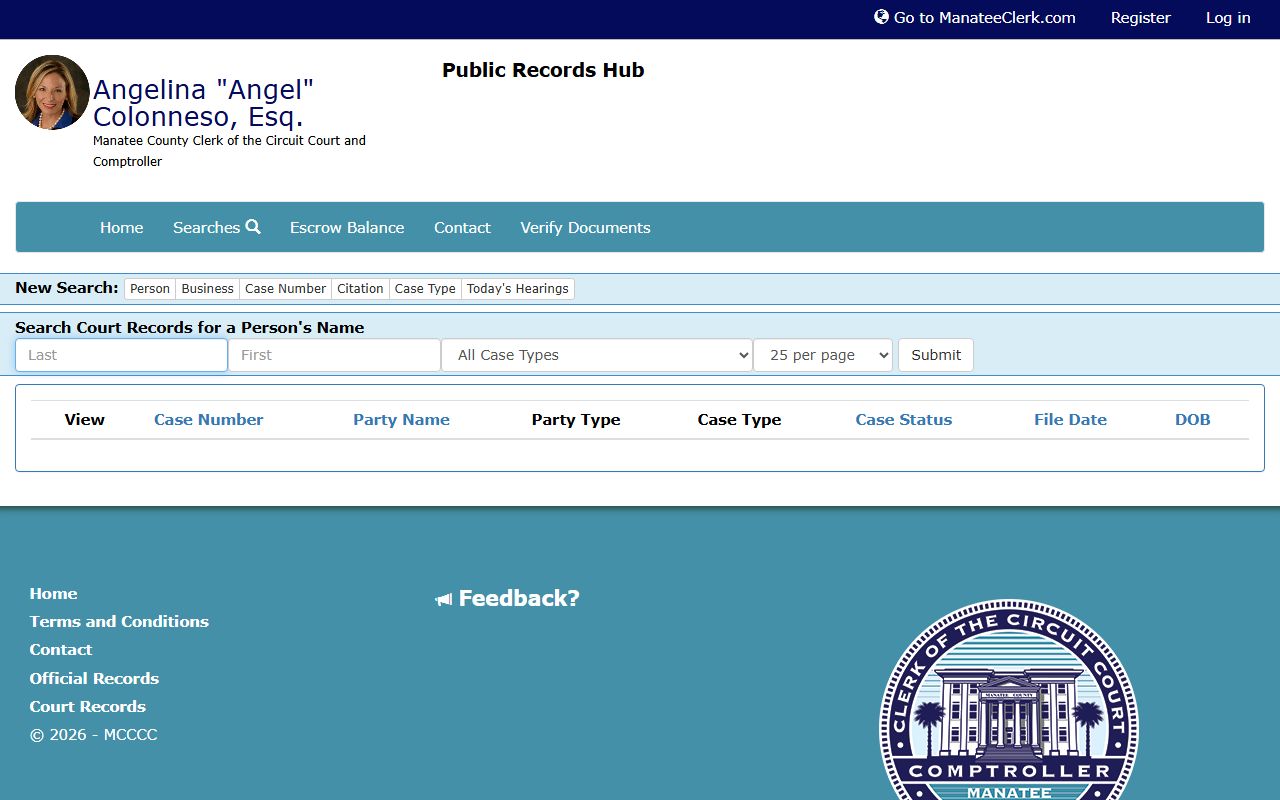
That screen takes a last name and an optional first name, with filters for case type and page size.
| Field Label | Type | Required | Notes |
|---|---|---|---|
| Last Name | Text | Yes for a person search | Main field for a defendant search |
| First Name | Text | No | Use with last name to narrow a common name |
| Case Type | Dropdown | No | Filter to Felony, Misdemeanor, Criminal Traffic, and more |
| Page Size | Dropdown | No | 25, 50, 100, or 250 results per page |
- Open the Clerk court records search.
- Search by the defendant's name, or by case number if you have it.
- Filter the case type to Felony, Misdemeanor, or Criminal Traffic.
- Open the result and read the charge list, status, and file date.
For a statewide criminal history rather than one county case, the Florida Department of Law Enforcement runs the state-level record check and the seal and expunge process. The sheriff routes statewide history questions to FDLE.
The Clerk also offers in-person help for court records. Public Access and Research sits on the main floor of the Historic Courthouse at 1115 Manatee Avenue West in Bradenton, reachable at (941) 741-4040, with general Clerk business at (941) 749-1800. The criminal division routes misdemeanor questions to (941) 741-4019 and felony questions to (941) 741-4043. An account is not needed to search public records, but some document viewing and expanded access can require registration or a subscriber agreement, especially for sensitive case types. The Clerk's posted hours run Monday through Friday, and the office cannot give legal advice.
How Charges Get Filed After an Arrest: Complaint, Information, and Indictment
The arrest does not set the final charges. After booking, the State Attorney for the Twelfth Judicial Circuit reviews the reports and files a charging document if the case goes forward. That office, led by State Attorney Ed Brodsky, prosecutes cases for Manatee, Sarasota, and DeSoto counties. Most Florida cases proceed by information. The most serious cases can involve a grand jury indictment.
The State Attorney's office is shown below.
View the Twelfth Circuit State Attorney bio.
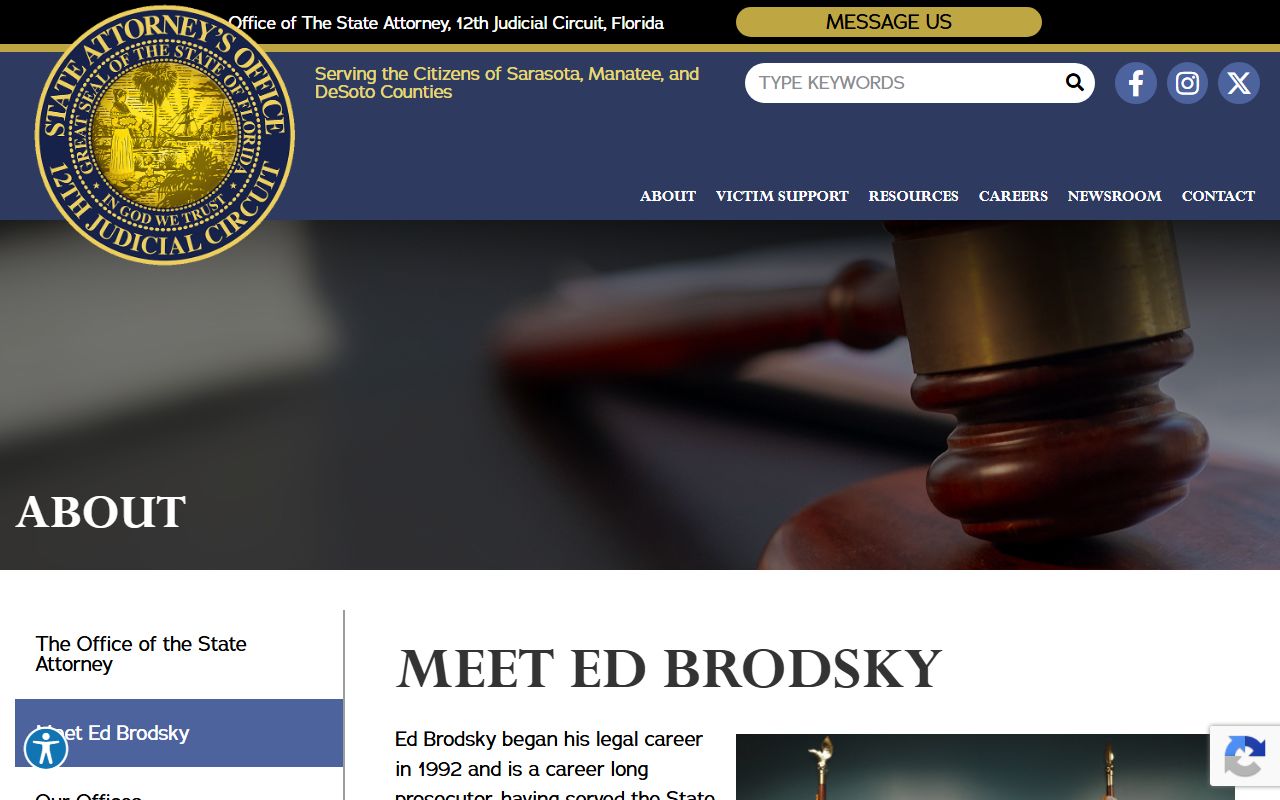
That office decides what is filed, so its choice, not the booking sheet, sets the charges in the court record.
The court level depends on the charge. Misdemeanors are handled in County Court and can lead to fines, probation, or up to a year in the county jail. Felonies are handled in Circuit Court and can lead to probation, county jail as a condition of probation, or a state prison term that ranges from a year to life in the most serious cases. The Clerk's Criminal Division manages the files for every arrestable offense in Manatee County, from minor charges to the most serious, and keeps the pleadings, hearings, exhibits, and judgments. Release from the jail does not close a case, since a person can be out on bond while the court matter continues.
| Complaint | Information | Indictment | |
|---|---|---|---|
| Filed By | Officer or prosecutor | Prosecutor | Grand jury |
| Common For | Misdemeanors | Many felonies | Serious felonies |
| Starts | The case | The case | The case |
Charge Status and What It Means
Charges shift as a case moves. A charge can be amended, reduced, added, or dropped. The booking charge at the jail can read differently from what the prosecutor finally files. The Clerk record is the reliable place to see the current count and status. Reading the status words correctly keeps you from assuming an outcome too early.
| Status | What It Means |
|---|---|
| Pending | The case is open and active, with no final result yet. |
| Amended / Reduced | The charge wording, statute, or level was changed or lowered. |
| Dismissed | The charge was dropped and is no longer being pursued. |
| Nolle Prosequi | The prosecutor chose not to pursue the charge. |
Note: A case status such as open or closed describes case management, not guilt, so read the docket and disposition before drawing a conclusion.
Bond and Release After an Arrest
Bond is set or adjusted at first appearance, which happens within 24 hours for people who do not bond out earlier. In Manatee, the jail accepts cash bonds 24 hours a day. Cashier's checks and money orders must be made payable to the Manatee County Clerk of Circuit Court with the booking number written on them. The jail takes the payment, but the Clerk processes a cash bond refund after the case is resolved. A hold can block release even when a dollar bond exists.
| Bond Type | How It Works |
|---|---|
| Cash Bond | Paid in full at the jail; the sheriff accepts cash 24 hours a day. |
| Surety Bond | Posted through a licensed bail bond agent for a fee. |
| PR / Own Recognizance | The judge releases the person on a promise to appear, with no money. |
| No-Bond Hold | A court order, warrant, or detainer keeps the person in custody. |
Warrants That Lead to an Arrest
Many bookings begin with a warrant. During intake, the jail runs a warrants check, and an open warrant can affect release and bond. Manatee has no separate public warrant search portal that was found in this review. The Clerk case search is the practical tool, since the case-type list includes search warrant entries, and a missed-court bench warrant shows on the case. The Clerk's criminal FAQ explains that failing to appear can bring a bench warrant, a bail forfeiture, and a possible license issue in traffic matters. A person facing a missed-court warrant may need to turn themselves in at the jail and post bail as the judge orders. If the person is outside Manatee County, the Clerk's guidance points to the closest law enforcement agency, after which a new court date is typically set a few weeks out.
It is worth saying clearly that a warrant is not something you clear online. The county does not publish a self-service warrant search, and official guidance describes turning oneself in and posting bail as ordered. For case-specific bench warrants or a search-warrant entry, the Clerk case search is the practical tool, and a lawyer is the right source for advice on how to handle an open warrant.
Charges vs. Convictions
An arrest and a charge are accusations. A conviction is an outcome. Both are public record, but they sit at different stages and carry different weight. Treating a charge as proof of guilt is both unfair and wrong.
| Charge | Conviction | |
|---|---|---|
| Stage | Accusation | Verdict or plea |
| Burden of Proof | Probable cause | Beyond a reasonable doubt |
| Public Record | Yes | Yes |
Florida also allows a withhold of adjudication in some cases, which can change whether a result counts as a conviction. That detail affects sealing eligibility and should be confirmed in the court record.
Sealed vs. Expunged Arrest Records
After a dismissal or an eligible outcome, a person can ask to seal or expunge a record. In Florida the process runs through the courts and the Department of Law Enforcement, with an application and fees at both FDLE and the Clerk. Sealing limits public access. Expunction goes further and treats the record as if it were destroyed. The Clerk routes seal and expunge questions to the governing statutes and to FDLE.
Eligibility is set by statute and is not automatic. An FDLE application and a certificate of eligibility usually come first, followed by a court petition, and outcomes such as a withhold of adjudication can affect whether a case qualifies. Because the rules are specific and the fees apply at more than one office, this is a place where reading the statute and speaking with a lawyer pays off. The court record, not the jail booking, is what gets sealed or expunged, so the case in the Clerk's system is the anchor for the whole process.
| Sealed | Expunged | |
|---|---|---|
| Visibility | Hidden from public view | Destroyed or treated as never existed |
| Law Enforcement | Limited access | Very limited access |
| Florida Statute | § 943.059 | § 943.0585 |
Background Check Considerations
A casual name search is not a background check. A regulated background check for hiring, housing, credit, or insurance must follow the federal Fair Credit Reporting Act and use a licensed provider. Court records found through a public index are useful for personal awareness, but they are not a substitute for an FCRA-compliant report, and they are not approved for those decisions.
Important: This site is not a consumer reporting agency under the FCRA, and its content may not be used for employment, tenant, credit, or insurance screening.
Restricted Court Records After an Arrest in Manatee County
Not every record is open to a routine search. Juvenile and adoption matters are handled separately and require a party and identification through the Family or Juvenile process. Sealed and expunged cases drop out of public view. Some documents in the Clerk hub carry a lock or a confidential icon. A lock means a document is viewable on request, often within a day after the user enters an email address. A confidential icon flags records made private by law or court order. When a public search returns nothing, a restriction may be the reason, not the absence of a case.